Avoid sample mistakes, extra costs & bulk rework with a complete outerwear tech pack. Check all required specs for padded jackets, OEM & ODM orders, including GRS, sizing, trims and AQL standards before sampling.
When you place bulk winter outerwear orders with a garment factory, the tech pack is your most important communication document between importers and manufacturers. It eliminates ambiguous verbal descriptions, ensures consistent fit across all sizes, and provides the factory with a clear blueprint to calculate pricing, raw material consumption and production timelines. Buyers frequently encounter mismatched samples, unexpected price hikes and shipment delays when key specifications are missing from the tech pack.
A well‑crafted outerwear tech pack goes far beyond a simple sketch or inspiration photo. It is a comprehensive specification document covering construction details, raw materials, trims, labeling standards, measurement tolerances and quality acceptance criteria. For padded jackets, down coats and puffers, even a single omitted detail can result in filling shifting, incorrect zipper hardware, faulty pocket construction, or hang tags that fail import compliance inspections. This detail is especially critical for custom puffer jacket tech packs.
Core Sections Every Outerwear Tech Pack Must Cover
Basic style information
Start with reference identifiers so your internal team and supplier can easily cross‑reference all documents. Include style number, style name, target sales market, season, gender/age category, order quantity and target FOB price range. Clarify whether the order is OEM (custom‑built to your exclusive design) or ODM (modified based on the factory's existing pattern).
Specify the sizing standard: US sizing, EU sizing, UK sizing or custom grading. Mixing different size systems without clear written notes is a common trigger for fit issues on cross‑border bulk orders.
Flat sketches and measurement points
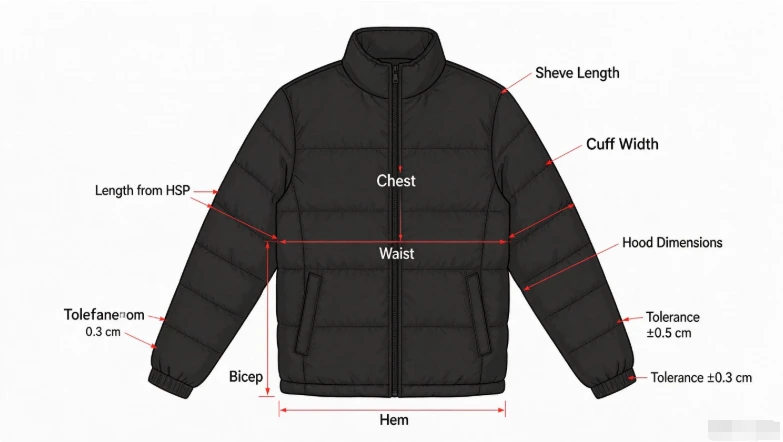
Prepare front, back and close‑up detail sketches. Mark every measurement point clearly: chest circumference, waist, hem, length from high shoulder point, sleeve length, bicep width, cuff width, and hood dimensions if applicable.
Attach a graded size chart covering every size in your assortment, not only the sample size. Define measurement tolerances. The figures below are for reference only; you may set your own standards: ±0.5 cm for chest, ±0.3 cm for cuffs and collars. Without agreed tolerance rules, buyers and factories often dispute whether finished garments meet requirements once bulk production is complete.
For padded outerwear, measurements taken on a flattened sample will differ from those of the finished, lofted jacket. Clearly state whether measurements are taken flat, relaxed, or worn on a body form, and whether filling is allowed to loft before measurement.
Shell, lining and fill specifications
This section carries the highest importance for padded outerwear sourcing.
Shell fabric: fiber composition, weight (GSM), weave structure, surface finish, DWR/water‑repellent treatment requirement, Pantone color reference, and washing shrinkage target.
Lining: material type, GSM, slippery coating, anti‑static requirement (if required).
Fill: specify down, feather or recycled polyester fill. Include fill power, fill weight per piece, fill distribution layout, plus GRS or RDS requirements where applicable.
We supply GRS-certified recycled down and recycled polyester padded jackets for bulk wholesale buyers. If you need GRS documents for your bulk order, you can check our guide about GRS certification for outerwear wholesale.
Some buyers only mark "puffer jacket" without defining fill weight. The factory may then use lighter filling to match the quoted price, and the final product will fail to deliver the advertised warmth performance.
Trims and hardware
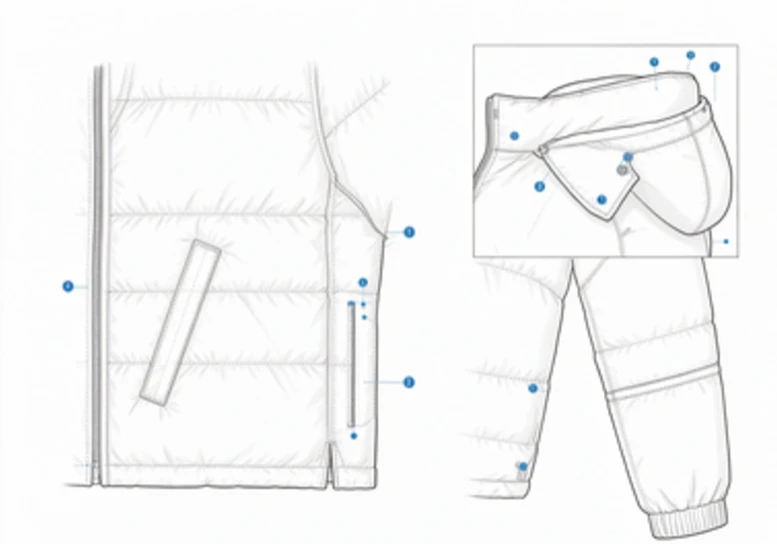
List every small component with part number, full specification and approved supplier standard.
Zippers: brand, coil or metal type, tape color, slider pull design and storm placket requirement.
Buttons, snaps and rivets: material, color, dimension and placement position.
Elastic: width and stretch ratio for cuffs, hem and hood opening.
Tapes, binding and bartacks: mark bartack locations at pocket corners, hood attachment points and high‑stress seams.
All trims must be matched to the approved color standard. Even a minor shade mismatch on zipper tape can make an entire batch look inconsistent on retail shelves.
Construction and stitching rules
Define seam type, stitch density (stitches per inch), seam allowance and quilting pattern for quilted styles. For quilted puffers, specify box stitch, channel stitch or diamond stitch, stitch spacing, and whether the filling is locked in place to prevent shifting after washing. This factor directly impacts your retail return rate.
Document every functional feature explicitly instead of relying only on photos: hidden pockets, inner security pockets, detachable hood, adjustable hem drawcord, reinforced elbows, two‑way zipper and internal hanging loop.
Labeling and packaging
Define all label types: woven main label, care label, size label, hang tag and flag label. Care symbols must comply with standards for your destination market. For the US, follow the FTC Care Labeling Rule (16 CFR Part 423). For the EU, care symbols follow EN ISO 3758. Fiber composition, country of origin, RN number or brand registration information must be clearly specified.
For packaging requirements, state polybag thickness, header card, folding method, carton dimensions and shipping marks, quantity per carton, plus size and color assort ratio. If individual barcode stickers are required, mark their placement.
Origin and labeling errors can trigger customs holds, so define these details formally inside the tech pack, rather than just mentioning them verbally.
Testing, compliance and acceptance criteria
List all mandatory lab tests and certificates for this style: OEKO‑TEX, REACH SVHC, GRS transaction certificate, RDS document, colorfastness, pilling resistance, shrinkage and DWR performance.
Set the AQL inspection standard in the tech pack. AQL 2.5 for major defects and AQL 4.0 for minor defects are widely adopted, with sampling plans referenced to ISO 2859‑1. Define what constitutes a major defect: broken zipper, skipped stitches, fill leakage, incorrect fabric or non‑compliant labels.
Also clarify who bears the cost of pre‑production testing, the deadline for submitting test reports, and whether inspection is conducted before packing or after loading.
Sample milestion schedule
Outline the sample sequence: proto sample, fit sample, PP (pre‑production) sample and sealed counter sample. Document what needs to be approved at each stage. Bulk production should only commence after signed PP sample approval. This protects you from the factory starting mass production before fit, fabric and details are confirmed.
Common tech pack mistakes
Relying solely on inspiration photos, with no dimensioned sketches or graded size charts. The factory judges the style visually, resulting in inconsistent fit across sizes.
Vague fill descriptions with no fill weight or fill power. Warmth performance fluctuates between batches.
No Pantone color reference, only simple descriptions such as "black" or "navy". Different dye lots create visible shade variation.
Missing measurement tolerance rules. Buyers and factories disagree on whether garments fall within specification.
Compliance requirements discussed verbally but not written into the tech pack. The factory fails to prepare required test reports or transaction certificates.
No clear AQL defect definitions. Quality disputes emerge after production is finished.
Trim specifications kept separate from the main tech pack. Wrong zippers, snaps or elastic are ordered by mistake.
These frequent oversights are the top reasons for delayed shipments and unexpected extra costs on jacket bulk orders.
Practical workflow to finalize your tech pack
First, collect all market regulatory requirements before drafting. Confirm labeling rules, chemical restrictions and testing obligations for your import destination countries.
Second, collaborate with your pattern maker to create graded measurements and mark all construction points. If you are modifying an ODM style, list every revision clearly. A note saying "change the pocket" is insufficient.
Third, share the draft tech pack with your supplier for quotation review. Ask the factory to flag any specifications that raise costs or extend lead time before you lock the order. Special requirements discovered only after sampling often lead to unexpected price adjustments.
Fourth, assign a new version number and redistribute the updated tech pack every time a change is approved. Avoid working from multiple outdated specification files. Fifth, archive the final approved tech pack, counter sample photos and lab report checklist by PO and style number for future reorders.
Frequently asked questions
Q: Can I place an order without a full tech pack if I buy ODM styles?
A: You may use the factory's existing tech pack as a base, but you still need a written addendum listing all your modifications, color selections, branding, labels and compliance requirements. Even small changes to pockets or zippers need proper documentation.
Q: How detailed does a tech pack need to be for basic bomber jackets or lightweight wind jackets?
A: It can be simpler than a down parka, but graded size charts, fabric specs, trims, labeling and AQL standards remain essential. Even simple styles can suffer from inconsistent fit and incorrect labeling.
Q: Who owns the tech pack and pattern after development?
A: Ownership terms should be agreed and written into your sales contract. If you fully fund pattern development, confirm ownership before sharing the tech pack with multiple manufacturers.
Q: What if the factory says my tech pack is too complicated?
A: Ask the factory to specify exactly which items add extra cost. Some specifications deliver tangible value by cutting return rates; others can be simplified to hit your target price. Make these trade‑offs consciously, and never remove mandatory compliance requirements such as GRS, REACH or FTC labeling rules.
A complete, precise tech pack is the foundation of stable, repeatable bulk outerwear orders. It cuts quality disputes, reduces rework risk and ensures samples match your design expectations.
View our wholesale down jacket and puffer jacket product range.
Send your design sketch or draft requirements to us, and we can help you build a professional tech pack for your next jacket bulk order. Contact Karen Lee at Tianjin Sunshine Era Garments Co., Ltd. | WhatsApp: +86 138 2088 9392