Mismatched test documents can block your shipment. Learn which certifications, lab reports and transaction certificates outerwear buyers need for bulk orders.
Wholesale outerwear importers bear compliance responsibility for every container they bring into markets including the US, EU and UK. Buyers often run into costly complications when a supplier provides a general certificate that does not correspond to the fabric, filling material or specific batch in the bulk order. The consequences may include customs holds, product recalls, financial penalties and unexpected delivery delays.
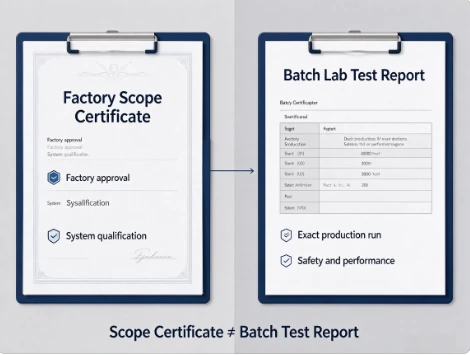
Certifications and lab test reports serve as traceable proof that your winter jackets, padded coats and puffers comply with chemical safety standards, material content claims and regional market regulations. A critical distinction to keep in mind: a factory's scope certificate is not equivalent to a batch-specific lab test report or a shipment-linked transaction certificate.
Core certifications for bulk outerwear orders
These are the most common documents you will encounter when sourcing padded jackets and insulated outerwear. Each one fulfils a unique purpose, which makes them easy to confuse. OEKO‑TEX STANDARD 100: The most widely recognised textile certification for chemical safety. It screens for restricted substances such as formaldehyde, banned azo dyes, heavy metals and phthalates. Outerwear fabrics typically fall under Class III, for materials that do not have direct, prolonged skin contact. Always verify that the certificate covers the exact shell, lining and fill specified for your order. A certificate issued for a different fabric lot cannot be used to validate your shipment.
GRS (Global Recycled Standard): This applies to jackets made with recycled polyester filling or recycled shell fabric. GRS validates recycled content percentages, supply chain segregation, chemical management controls, plus basic social and environmental requirements. A factory's GRS scope certificate confirms the facility is authorised to process GRS materials. To authenticate a particular shipment, request a GRS Transaction Certificate (TC) tied to the order's weight and production batch.
RDS (Responsible Down Standard): Required if your product range uses natural down. It verifies the down is sourced without live plucking or force‑feeding. Buyers usually need both the supplier's valid RDS scope certificate and a matching transaction certificate for the down batch.
REACH / SVHC: Mandatory for shipments to Europe. REACH regulates substances of very high concern (SVHCs) listed on the candidate list. Many buyers ask suppliers for test reports reviewed against the latest SVHC inventory. OEKO‑TEX testing frequently accompanies this requirement, but it remains a separate compliance check.
Social compliance audits (BSCI, SMETA, WRAP): These cover factory labour conditions, working hours, site safety and wage standards. Some retail distributors and wholesale brands require a recent audit report before approving a new supplier. Unlike product certificates, social compliance audits apply to the factory premises, not a single garment batch.
Batch-specitic lab test reports ot request
Certifications prove a system or material qualification. Lab test reports demonstrate safety and performance for your exact production run. For bulk outerwear, add this checklist to your order confirmation:
Fabric chemical test report matching the batch number, including REACH SVHC testing where applicable
Colour fastness tests: rub fastness, wash fastness and light fastness
Physical fabric performance tests: tear strength, seam strength, pilling resistance and dimensional stability after laundering
Fill power and fill content testing for down jackets, if you market warmth performance claims
Water‑repellent (DWR) performance report, if the jackets are advertised as water‑resistant
Labelling verification: fibre content tags matching tested composition, country of origin marking and care symbols
A frequent mistake is accepting a test report from a previous season or a different colourway. Dye lots and finishing treatments can alter performance, so every bulk production run should have its own test documentation. Ask your supplier to clearly mark the PO number, style number and batch ID on every report.
Red flags to watch for
Expired certificates, or certificates issued by an unaccredited body
Certificate scope does not cover the shell fabric, lining or fill used for your order
Supplier only provides a scope certificate and refuses batch‑specific lab reports or TC documents
Report dates predate the production run with no reasonable explanation
Hang tag material claims conflict with composition results on the lab report
Testing is completed by a non‑independent, unrecognised third party such as SGS, Intertek or Bureau Veritas
These issues can also spark disputes with your retail customers once goods arrive at destination. Some wholesale distributors reserve the right to reject shipments if supporting documentation fails to back up product specifications.
Practical workflow to lock in compliance
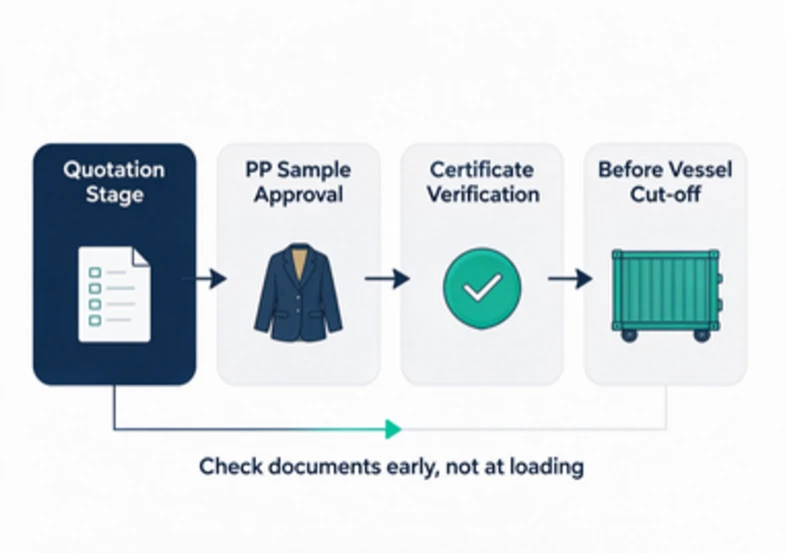
First, share your document checklist with the supplier at the quotation stage. Clarify which certificates and test reports are required before shipment, and who bears testing costs. Some factories include standard tests within their pricing, while specialised or multi‑standard testing may be charged to the buyer. Sorting this out early prevents unexpected extra fees.
Second, review all documentation during PP sample approval. Do not wait until goods are packed for shipping. If documents are mismatched or certificates are expired, you still have time to switch materials or source replacement batches before mass production begins.
Third, validate key certificates through the issuing certification body or its official certificate database. This helps identify altered or counterfeit certificates before you commit to the order.
Fourth, collect all final documents (lab reports, TCs and compliance declarations) before the vessel cut‑off date. Store digital copies filed by PO and batch number, for the retention period required by your contracts and local market rules.
Frequently asked questions
Q: Does OEKO‑TEX automatically satisfy REACH requirements for EU orders? A: Not exactly. OEKO‑TEX testing aligns with many REACH limit values, but it does not serve as an official REACH declaration. If you serve EU wholesale clients, confirm the test report explicitly covers the current SVHC candidate list.
Q: Do I need a TC for every GRS order? A: Yes, if you make recycled‑content claims for that shipment. The scope certificate shows the factory holds certification, while the TC links the recycled raw material directly to your specific container.
Q: Can testing be carried out after production finishes? A: It is technically possible, but it carries significant risk. A failed test may trigger rework, re‑dyeing or full remakes, which delay delivery and raise costs. Testing pre‑production sample material is far safer for seasonal bulk programs.
Q: What happens if documents get rejected at the port? A: Outcomes differ by country. Shipments may be detained, inspected, denied entry or returned, and importers may face fines in some jurisdictions. This is why buyers should complete document checks before loading cargo.
Robust certification and lab documentation protect your brand, reduce customs compliance risk and build confidence for your retail customers buying your outerwear line. If you are defining compliance requirements for your next bulk jacket order,
contact us